Friday, 8 July 2016

Aadhaar Card Status Online

How to Check Aadhaar Card Status Online
  
  Applied for an Aadhaar card but still haven't received it? You can easily check the status of your application online. All you need is a copy of the acknowledgement slip that you are given after your visit to the enrolment centre. If you have that, then this is an easy process.
   An Aadhaar card is an official government-issued identity card for Indians. Many government institutions accept this card as a proof of identity and some require that you produce your Aadhaar card. The card is issued by the Unique Identification Authority ofIndia (UIDAI) on behalf of the government. It's steadily being linked to a growing number of government functions, and continues to grow in importance, so it's probably a good idea to get an Aadhaar card, even if you don't necessarily need one yet.
  Follow these steps to check the status of your Aadhaar card application online.
  1.   Head to the Aadhaar status page on the UIDAI website.
  2.  Check your Aadhaar acknowledgement slip. At the top you will see the 14-digit     enrolment number and a 14-digit date and time of enrolment.
  3.   Key in these two numbers in the EID and Date/ Time fields respectively.
  4.  Type the captcha in the field labelled Enter the Security Code.
  5.  Click Check Status.
  This will reveal the status of your Aadhaar enrolment application. This is only for checking the status of a new application. If you have misplaced your card, and want to print out a copy that you can use, then check out how to download a copy of your Aadhaar card.

Thursday, 7 July 2016

Nasa's Juno Mission

Nasa's Juno Mission Enters Jupiter's Magnetic Field


  Nasa's Jupiter-bound Juno spacecraft has entered the planet's magnetosphere, where the movement of particles in space is controlled by what's going on inside Jupiter.

  Juno is on course to swing into orbit around Jupiter on July 4.


  "We've just crossed the boundary into Jupiter's home turf. We're closing in fast on the planet itself and already gaining valuable data," said Scott Bolton, Juno principal investigator, from Southwest Research Institute, San Antonio, in a statement on Thursday.


  Science instruments on board detected changes in the particles and fields around the spacecraft as it passed from an environment dominated by the interplanetary solar wind into Jupiter's magnetosphere.


  The obstacle is Jupiter's magnetosphere, which is the largest structure in the solar system.


  "If Jupiter's magnetosphere glowed in visible light, it would be twice the size of the full moon as seen from Earth," Kurth said.


  Out in the solar wind a few days ago, Juno was speeding through an environment that has about 16 particles per cubic inch (one per cubic centimeter).


  Once it crossed into the magnetosphere, the density was about a hundredfold less.


  The density is expected to climb again, inside the magnetosphere, as the spacecraft gets closer to Jupiter itself.


  The motions of these particles travelling under the control of Jupiter's magneticfield will be one type of evidence Juno examines for clues about Jupiter's deep interior.

Wednesday, 6 July 2016

Mars Was Once Earth-Like

Presence of Manganese Oxide Indicates Mars Was Once Earth-Like

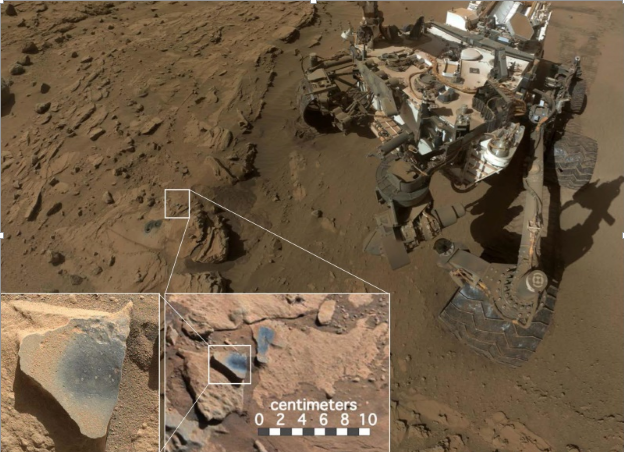
 Nasa's Curiosity rover has observed high levels of manganese oxides in Martian rocks which indicates that higher levels of atmospheric oxygen once existed on Red Planet.
  The discovery tells that the Red Planet was once more Earth-like than previously believed.
  The hint adds to other Curiosity findings - such as evidence of ancient lakes - revealing how Earth-like our neighbouring planet once was.
  "The only ways on Earth that we know how to make these manganese materials involve atmospheric oxygen or microbes," said Nina Lanza, planetary scientist at Los Alamos National Laboratory and lead author on the study.
  "Now we're seeing manganese-oxides on Mars and wondering how the heck these could have formed," she added in a paper appared in the journal Geophysical Research Letters.
  To reach this conclusion, Lanza used the Los Alamos-developed ChemCam instrument that sits a top Curiosity to "zap" rocks on Mars and analysed their chemical make-up.
  In less than four years since landing on Mars, ChemCam has analysed roughly 1,500 rock and soil samples.
  "These high-manganese materials can't form without lots of liquid water and strongly oxidizing conditions," said Lanza.
"Here on Earth, we had lots of water but no widespread deposits of manganese oxides until after the oxygen levels in our atmosphere rose due to photosynthesizing microbes," the author noted.
  One potential way that oxygen could have gotten into the Martian atmosphere is from the breakdown of water when Mars was losing its magnetic field.
 "It's thought that at this time in Mars' history, water was much more abundant," said Lanza.
  The next step is for scientists to better understand the signatures of non-biogenic versus biogenic manganese, which is directly produced by microbes.
  If it's possible to distinguish between manganese oxides produced by life and those produced in a non-biological setting, that knowledge can be directly applied to Martian manganese observations to better understand their origin.

Tuesday, 5 July 2016

Robot That Can Connect Emotionally With People

Sony to Develop a Robot That Can Connect Emotionally With People

  Japanese tech giant Sony announced on Wednesday that it was working on developing a robot which can connect emotionally with people, and expects to launch it soon.
  This will mark Sony's return to the market of artificial intelligence (AI), robots for homes, an area the company pioneered in 1999 when it launched its robotic dog Aibo, which it stopped manufacturing in 2006, EFE news reported.
  At a press conference on Wednesday, where the company unveiled its strategy for 2017, Sony President Kazuo Hirai said they want to make robots capable of winning people's affection.
  Sony is looking to combine its strengths in audiovisual technologies and home entertainment with the latest advances in robotics and AI, to introduce a new business model that will offer new experiences to users, he added.
  Last month, Sony acquired a stake in the US startup Cogitai, which specialises in creating continual AI learning programmes.
  Hirai also said the launch date for Sony's new home robot - which will be directly in competition with Softbank's android robot "Pepper", launched in June 2015 - has not been decided yet.

  He set an operating profits target of over $4 billion for the next fiscal and said the company is optimistic about continuing to grow owing to its entertainment and electronics divisions.

Monday, 4 July 2016

Twitter

Twitter Dashboard App to Help Small, Medium Businesses Connect With Customers
  To help business owners connect with their users, micro-blogging website Twitter has launched Twitter Dashboard - an app to streamline engagement for business accounts.
  Available on iOS, it can also be accessed on the Web. Twitter in its blog post introducing Dashboard said it is a place for businesses to "share news, tell stories, and have conversations that support, educate, and delight their customers."
  The company said Dashboard can help small and medium businesses engage with their audiences by creating a custom feed that shows what's being said about them on the social network. The tool will also help schedule tweets. Twitter will also provide "Tweet tips geared just for businesses," which will help start conversations and engage audiences.
  Earlier this week, Twitter added a new feature that would let a user add virtual stickers to photos by just searching them like hashtags.
  The company is also creating collections of stickers that are linked to the time of year and events such as New Year and Christmas. The new feature was similar to adding a sticker to a Snapchat post where a user can resize, rotate and add multiple stickers to each post.
  Twitter's management has been doing everything to get the company back on its feet.
  Recently, it acquired 18-month-old London-based startup Magic Pony Technology to expand its capabilities in machine learning and artificial intelligence (AI).
  The announcement came a week after Twitter invested $70 million in popular music streaming serviceSoundCloud to push its stalled growth amid rumors that technology giant Google might soon acquire the company.
  The 10-year-old Twitter has been facing stalled user growth and growing competition for quite some time. A sequential decline in its monthly active users (MAUs) base triggered a sharp fall in Twitter shares as the company announced its fourth quarter results recently.

Saturday, 2 July 2016

Breast Cancer

Nasa Technology Reveals Bacteria's Role in Breast Cancer

  Using planetary protection techniques that ensure Nasa spacecraft do not contaminate other worlds, researchers, including one of Indian-origin, have found a link between bacteria in breast ductal fluid and breast cancer.
  The breast ductal system contains the glands that produce milk and naturally secretes a substance called "nipple aspirate fluid".
  For the study, the researchers at Nasa's Jet Propulsion Laboratory, Pasadena, California, employed the same sequencing and analysis methods used for examining bacteria in spacecraft assembly rooms.
  "We applied these planetary protection techniques in the first-ever study of microorganisms in human breast ductal fluid," said Parag Vaishampayan, scientist in biotechnology and planetary protection at JPL.
  The researchers found differences between the ductal fluid bacteria found in women who have experienced breast cancer, and the bacteria present in those who have not.
  The findings were published in the online journal Scientific Reports.
  The research team found that the community of microorganisms in breast ductal fluid differed significantly between two groups - 23 healthy women and 25 women who had a history of breast cancer and had gone through treatment.
  It was then analysed with next-generation genomic sequencing, which has also been used for examining bacteria in Nasa spacecraft assembly facilities.
  For the study, Nasa scientists collaborated with cancer researchers from different institutions.
  "Collaboration between JPL space technology experts and medical researchers will continue to propel groundbreaking discoveries," Vaishampayan, who earned in PhD from University of Pune in Maharashtra, said.
  "This publication represents a success for JPL's Medical Engineering Forum Initiative, which focuses on applying Nasa technology for medical needs here on Earth," JPL's Leon Alkalai, who is spearheading the initiative said in a statement.
  Though the study found a correlation between specific species of bacteria and women who have gone through breast cancer treatment, the cause of the bacterial population difference is unclear.
 .

Friday, 1 July 2016

Water Sites on Mars

Nasa to Drive Curiosity to Potential Water Sites on Mars
  The US space agency is planning to drive the Curiosity Rover towards water sites on the Martian surface to further investigate the long, seasonally changing dark streaks briny water in the hope of finding evidence of life.
  "It is not as simple as driving a rover to a potential site and taking a scoop of soil," said Jim Green, Nasa's director of planetary science.
  "Not only are these on steep slopes, we need to ensure that planetary protection concerns are met. In other words, how can we search for evidence of life without contaminating the sites with bugs from Earth?," he added in a Nasa statement.
  After approval of mission extension, Nasa's Curiosity Mars rover would continue to climb to higher and younger strata on Mount Sharp - mountain in Gale crater - to investigate how the ancient, water-rich environments found till now persisted as the red planet dried out.
  A stroll on these destinations would help the one-tonne rover closer to locations where dark streaks are present on slopes and allow it to capture images of the potential water sites from miles away and see if any are the seasonally changing type.
  Nasa's High-Resolution Imaging Science Experiment (HiRISE) camera on the Mars Reconnaissance Orbiter (MRO) has observed many features of interest. They appear as dark lines that appear to ebb and flow over time.
  "Planetary scientists think these gullies or recurring slope lineae (RSLs) may appear seasonally as a form of briny water at or near the surface of the Red Planet under warmer conditions," Nasa said.
  Nasa is also worried about how close could the rover safely get to an RSL?
  "In terms of coming much closer, we need to understand well in advance the potential for Earth organisms to come off the rover and that will tell us how far away the rover should stay," said Catharine Conley, Nasa's planetary protection officer.
  The darkish streaks are considered "special regions" on Mars, where extra precautions must be taken to prevent contamination because of the suspected presence of liquid water, considered a prerequisite for life.